

Ask most residents when their building’s water tank was last cleaned, and the honest answer is usually a shrug. The taps still run. The pressure is fine. Nobody has ever mentioned a problem — so nobody has ever asked. That absence of complaints is often mistaken for evidence that the tank is fine. It isn’t. It’s usually evidence that nobody has looked.
The gap that opens up at handover
From the day residents collect their keys at Vacant Possession (VP), water tank maintenance sits in a genuine grey area for longer than most owners realise. The developer’s Defect Liability Period runs for 24 months from VP under the Housing Development Act, covering construction defects. Separately, under the Strata Management Act 2013 (Act 757), the developer remains responsible for maintaining common property — including the water tank — only until one month after the Joint Management Body’s first Annual General Meeting, which itself must be convened within 12 months of VP. In practice, that’s a management window of roughly 13 months, and it can be longer where an extension is granted.
Within that window, and often for a long stretch after it, tank maintenance isn’t always anyone’s clear, active priority. The developer’s team is focused on closing out defect claims. A newly formed JMB is finding its feet, appointing a managing agent, and working through its own list of urgent issues. A first professional inspection of the tank — the one that would tell anyone what’s actually happening inside — is easy to push down the list indefinitely, because until something visibly goes wrong, there’s no obvious reason to open the hatch.
What actually builds up, over time
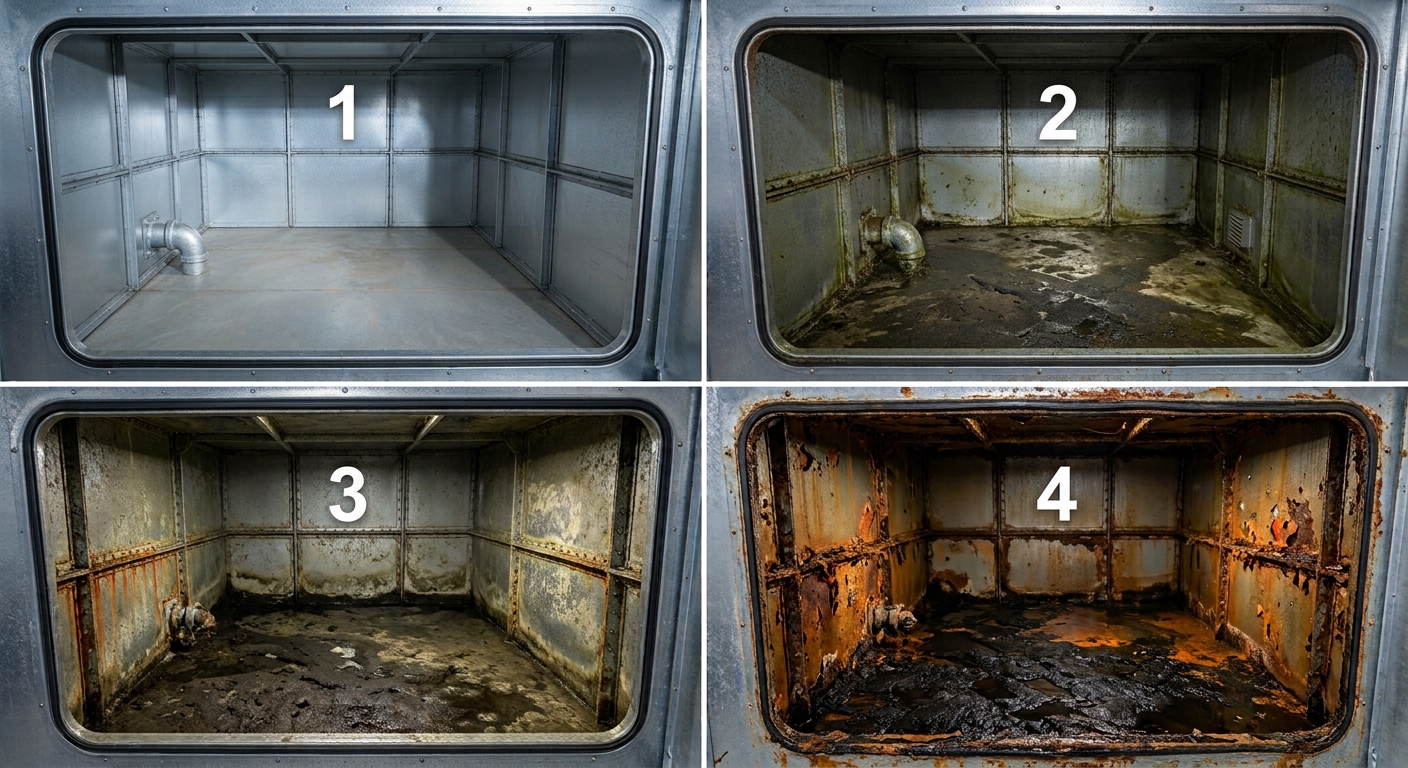
- First few months: fine construction dust, sand, and residue from newly installed pipework settle at the bottom of the tank — a normal by-product of a new building that a first cleaning would simply flush out.
- 6–12 months: without that first clean, the sediment layer thickens. Organic debris and insect matter entering through vents and access points accumulates, and a thin biofilm — a slimy bacterial layer — begins forming on the tank’s interior surfaces, particularly in the corners and dead zones where water sits relatively still.
- 1–3 years: sediment continues to build, and corrosion typically begins at panel joints, gaskets, and metal fittings. Rust particles start entering the water column. Crucially, the biofilm layer also thickens — and it can shield bacteria from the residual disinfectant already present in treated supply water, letting bacterial regrowth continue even though the water entering the tank was clean.
- Several years, untouched: by this stage it’s common for a first cleaning job on a long-neglected tank to turn up a visible sludge layer, rust flaking from panel joints, and water that discolours or develops a metallic or musty smell whenever the tank is disturbed — for instance after the water level drops and refills.
Why this is a genuine concern, not just a housekeeping issue
Stagnant, sediment-laden water sitting at a warm temperature is a recognised risk factor for bacterial growth, including organisms such as Legionella, which proliferate in roughly the 20–45°C range. Malaysia’s climate makes this worth taking seriously: an exposed rooftop tank can sit well within that range for much of the day, year-round, in a way that tanks in cooler climates simply don’t. This doesn’t mean every uncleaned tank is a health emergency — but it does mean “the water still runs fine” is not the same as “the water is fine.”
The more immediate signs residents actually notice tend to be less dramatic, but still real:
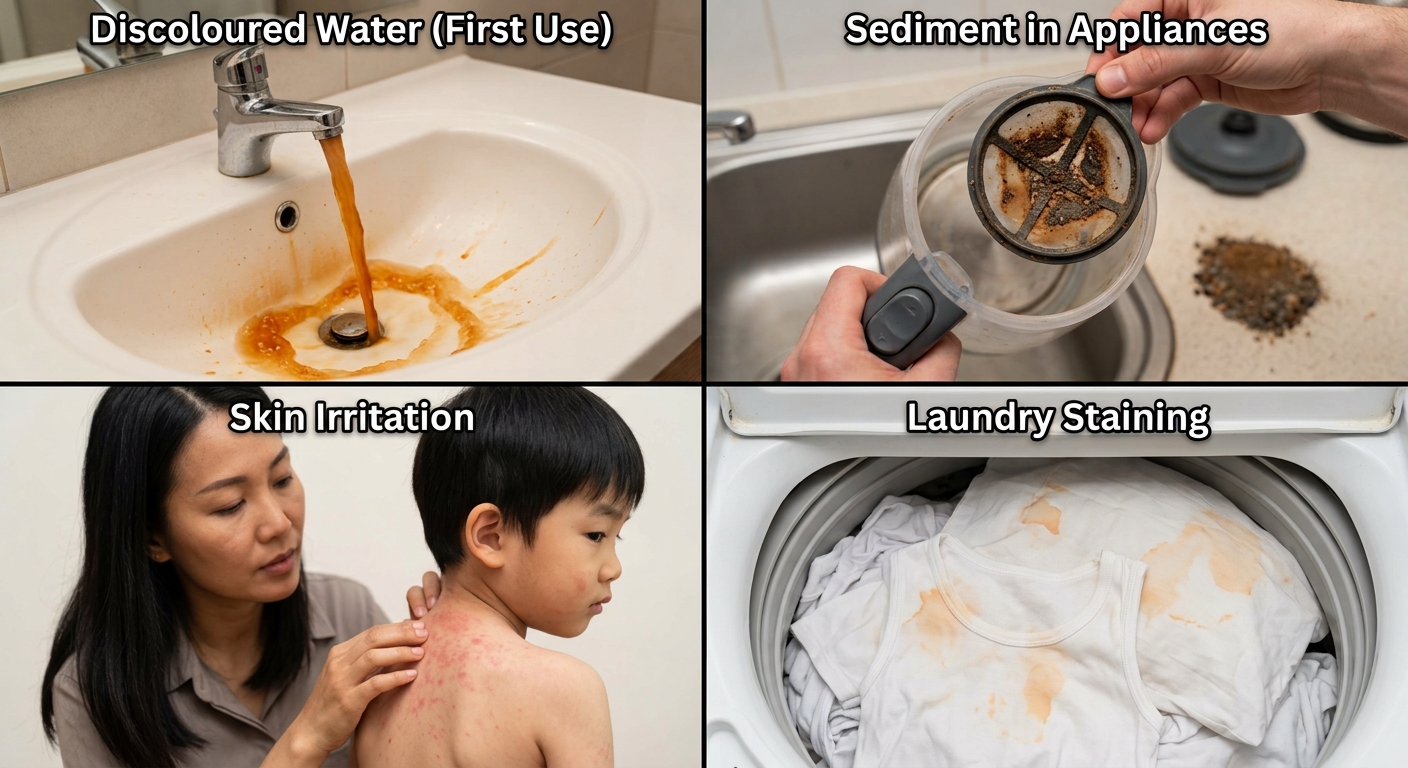
- Discoloured or rust-tinged water, especially first thing in the morning or after the tank refills
- A metallic or musty smell that wasn’t there when the building was new
- Sediment or grit turning up in kettles, shower filters, or washing machine inlets
- Skin or scalp irritation reported by residents with sensitive skin, particularly children and the elderly
- Staining on light-coloured laundry that a regular detergent won’t fully remove
The cost of waiting
There’s also a structural and financial consequence that compounds quietly. Corrosion at panel joints that’s caught during a routine annual clean is typically a straightforward repair. The same corrosion, left unseen for three or four years because the tank was never opened, is far more likely to have progressed into a genuine leak — turning what should have been routine maintenance into an unplanned structural repair, at a materially higher cost to the JMB or MC’s maintenance fund than a scheduled programme would ever have required.
The fix is simply starting
None of this requires alarm — it requires a starting point. A tank that has never been professionally opened since VP doesn’t need a crisis response; it needs a first inspection, a proper clean, and a documented annual schedule going forward. The earlier that starts after handover, the less there is to find, and the cheaper it stays.

If your building’s water tank hasn’t been professionally inspected since handover — or nobody on the committee is quite sure when it last was — that’s the exact situation worth acting on now, not after the next complaint. Bestway Bina carries out first-time inspections and cleaning for newly handed-over developments across the Klang Valley, with a full condition report so your JMB or MC knows exactly what’s inside and what to schedule next.
Bestway Bina Sdn. Bhd. — The Water Tank & Facility Specialists
010-266 1853 | bestwaybina@gmail.com | besttankservice.com.my